
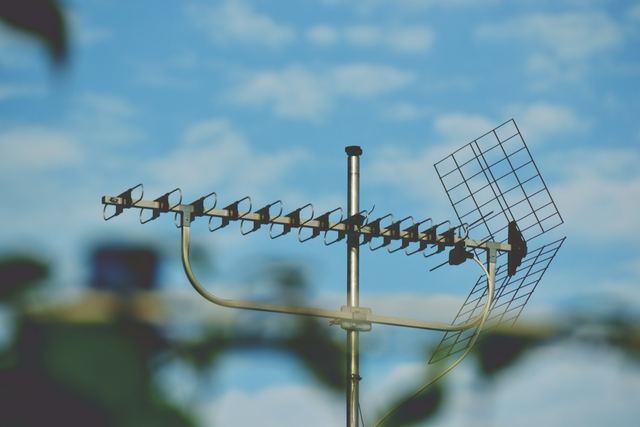
Aerial or dish down near a power line?
If wind has brought an aerial, dish or cable down onto or near a power line, treat the line as live. Stay at least 10 metres away, keep everyone else back and call 111, then let your lines company know. And don't get up on the roof to re-aim or fix an aerial yourself: leave roof work to someone with the right gear.
Who does what
An aerial installer mounts the aerial or dish, aims it and runs the coax cable to the TV. Many do nothing else, and that's fine if there's already a power point beside the TV.
An electrician who does AV work can do the cabling and the power together: a recessed power point behind the TV, cable runs inside the wall instead of across it, and extra TV points in other rooms. Some put up aerials too, but not all, so say exactly what you need when you ask.
Wall-mounting a TV the tidy way
Hiding the cables properly needs a power point behind the TV, not an extension lead pushed through the wall. Leads aren't made to live inside a wall cavity, and a fault in there is hard to see.
Ask for the outlet to sit where the bracket won't squash the plug, and for a way to get the signal and HDMI cables down to the cabinet below. Check the wall as well: plasterboard alone won't hold a big screen, so the bracket needs studs or proper fixings.
Aerial, dish or internet?
Free-to-air channels can come in through a roof aerial or a satellite dish, and more and more viewing now arrives over the internet. If you mostly stream, a solid network point behind the TV may help more than a new aerial. Data cabling and TV points covers that side.
If an aerial worked before and suddenly doesn't, the cause is often the cable, a connector, or the aerial knocked out of line by wind. That's an aerial installer's job, unless something electrical is also wrong.
The paperwork for the electrical part
Adding or replacing a power point is prescribed electrical work, and it comes with an Electrical Safety Certificate (ESC). Replacing an outlet is low-risk work. A new outlet or circuit is general work, so you get a Certificate of Compliance (CoC) as well. None of it is high-risk.
Before an electrician starts, ask to see their licence ID. It shows who they are, their registration class and when the licence expires, and you can check them on the public register run by the Electrical Workers Registration Board (EWRB).
Your part, and the licensed part
You can
- Tune the TV and set up streaming apps.
- Choose where the TV goes, and ask what's behind that wall.
- Plug the TV and devices into existing power points.
- Stay off the roof.
Leave to a licensed electrician
- A power point behind a wall-mounted TV.
- New circuits for a home theatre or a big AV setup.
- Anything at the switchboard.
- Any power point work in a rental, where landlords and tenants can't do electrical work.
Ask before you book
- Do you do the aerial, the power and the cable runs, or only some of it?
- Will the power point behind the TV be recessed, so the screen sits flat?
- How will the cables get from the TV down to the devices?
- What certificate will I get for the electrical work?
- Can I see your licence ID?

What we'd do
For a wall-mounted TV, we'd get one electrician who does AV work to plan the power point, the cable route and the network point together, and call an aerial installer only if the aerial itself needs work. If it really is just a dish or an aerial, an aerial specialist is often the quicker fit.
Want a specialist to sort it?
Tell us the job and your postcode. We match the licence-checked local electrician who does this kind of work, and they call you. No ring-around, and your number goes to them alone.