
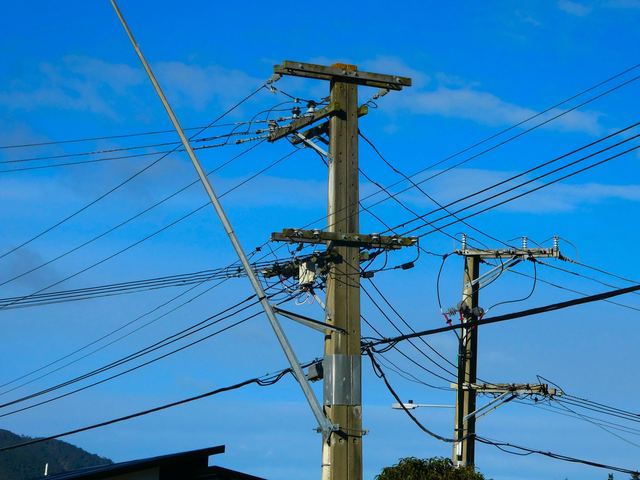
Single-phase and three-phase in plain English
A single-phase supply brings one live conductor into your home, plus a neutral. A three-phase supply brings three live conductors, each carrying power that peaks at a slightly different moment from the other two. Together they deliver more capacity, and larger motors run more smoothly on them.
Inside the house, your electrician spreads the circuits across the three phases so each one carries a share of the load. Lights and ordinary power points still run on a single phase. Some large appliances and machines are built to use all three.
Who might need it
Workshops and sheds with three-phase machinery, like larger compressors, welders or woodworking gear.
Homes with several big loads at once: a large house with multiple heat pumps, an induction cooktop, a spa and an EV charger, all running on a cold evening. An electrician can assess the home's maximum demand to see whether single-phase still copes.
Larger solar systems. Lines companies set different limits for single and three phase. WEL Networks, for example, treats solar up to 10 kW single phase or 30 kW three phase as a small connection, and MainPower assesses three phase solar case by case.
Each lines company sets its own standard sizes. Electra's standard connections are single phase up to 63A and three phase up to 40A per phase, and anything larger needs a separate application.
Do you need it for an EV charger?
Often not. WorkSafe's January 2026 addendum to its EV charging guidelines says that with advanced load management, a 32 A (7.5 kW) charger is likely to give enough charge for a typical day's driving without raising a typical home's peak consumption. For vehicles with a range of 350 km or more that need a full charge overnight, it says some upgrading of the wiring may be needed.
PowerNet also points out that not all EVs support three phase charging, so a three-phase charger may not charge your car any faster. Network Tasman notes there are limits on how much charging power a home can have before its connection needs a capacity upgrade. That's a question for your electrician and lines company before you buy a charger, not after.
Your lines company decides
Your lines company owns the network up to your property boundary, and changing an existing connection goes through them. Your retailer arranges the meter. Every connection has its own ICP (installation control point) number, which you'll need for the paperwork.
The process varies by company. Top Energy says you must apply before upgrading an existing supply, for example from single to three phase. On Westpower's network, single to three phase upgrades go through an electrical contractor's works request. Orion's connections process covers capacity upgrades, including for an EV charger, and Aurora Energy asks you to apply before altering your connection or adding notifiable loads such as EV charging or heat pumps. In the Wellington Electricity area, capacity upgrades are requested through your retailer.
Not sure who your lines company is? The ENA lines company map shows it when you enter your address.
How an upgrade usually goes
List what you have and what's coming
Heat pumps, cooktop, hot water cylinder, spa, workshop gear, EV, solar. Planned loads matter as much as current ones.
Get an electrician's assessment
They'll look at your current supply, your switchboard and your maximum demand, and tell you whether three-phase is needed or whether load management would do.
Apply to the lines company
Vector recommends talking to a registered electrician before applying. Who submits the application varies, so ask your electrician to handle or guide it.
The work on your side
Your electrician does the cabling and switchboard work on your property. On Vector's network, the final connection is made by a Vector-approved contractor or livening inspector.
Meter and livening
Your retailer arranges the meter, which must be in before the supply is livened. Then you get your certificates.
The paperwork for supply work
The EWRB classes mains work as high-risk, and installing a higher-capacity switchboard is high-risk too. High-risk work needs a Certificate of Compliance, an Electrical Safety Certificate and an independent inspection by a licensed electrical inspector, who issues a Record of Inspection. The job isn't legally complete until both the CoC and the Record of Inspection are issued.
Your electrician arranges the inspector. Ask at the start who that will be and how it fits around the lines company's timing.
You might already have it
Some older homes already have more than one phase. The Power Company, which serves rural Southland and West Otago, notes many older multi-phase homes on its network. An electrician can tell you what you've got from your switchboard and meter, and whether the extra phases are being used.
Your part, and the electrician's
You can
- Write down every big appliance you have and plan to add.
- Find your ICP number, usually on your power bill, and your lines company on the ENA map.
- Ask your retailer about the meter once the lines company has approved the change.
Leave to a licensed electrician
- Assessing maximum demand and whether three-phase is needed.
- Preparing or guiding the application to the lines company.
- Mains and switchboard work, which is high-risk work.
- Arranging the licensed electrical inspector.

Our take
We wouldn't ask for three-phase until an electrician has looked at what we actually run and what's coming. For many homes, especially for EV charging, a well-planned single-phase setup with load management is enough. If you do need it, start the lines company conversation early, because their timing usually sets the pace of the whole job.
Want a specialist to sort it?
Tell us the job and your postcode. We match the licence-checked local electrician who does this kind of work, and they call you. No ring-around, and your number goes to them alone.