
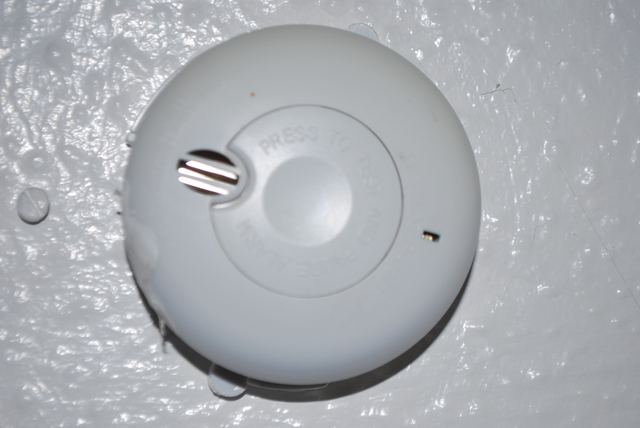
How they work
A hard-wired alarm is connected to a circuit in the house, often through a mounting base on the ceiling, so the alarm head can be swapped without disturbing the cable. A backup battery, frequently sealed in, keeps it going in a power cut.
A small light on the alarm shows it has power. If that light is out, or the alarm chirps, the unit or its supply needs checking. A chirp from a hard-wired unit is often its backup battery, or the alarm reaching the end of its life.
Many hard-wired models can also be linked, so one alarm triggers the rest. Interconnected smoke alarms explains how that works.
When hard-wired makes sense
They suit extensions and renovations where the ceilings are open, homes where someone can't easily reach the ceiling to deal with batteries, and landlords who'd rather not rely on batteries between tenancies.
In a finished house, long-life photoelectric battery alarms are usually the quicker option, and both types are acceptable in a rental.
Hard-wired alarms in a rental
Tenancy Services' landlord guide calls a hard-wired system an acceptable alternative and applies the same requirements: a sensor in each bedroom or within 3 metres of each bedroom door, plus at least one alarm on each storey or level.
Landlords must maintain a hard-wired system to the manufacturer's requirements. The guide adds that an alarm with no replacement date, more than 8 years old, or of unknown age is one the landlord will need to replace to be certain of complying.
To do that work, a landlord can enter with 24 hours' notice, between 8am and 7pm. Tenants mustn't disconnect a smoke alarm, and in a rental only someone who's registered and holds a current practising licence may do electrical work, so a faulty hard-wired alarm is the landlord's to sort, through a licensed electrician.
Replacing a hard-wired set
Check the dates
The manufacture or replace-by date is usually printed on the alarm. An electrician can read the ones you can't safely reach.
Match or upgrade
Replacement heads that fit the existing bases are the simplest swap. If that model is gone, new bases go in too.
Keep the link
If the alarms are interconnected, replace the whole set at once so they keep talking to each other.
Test and record
Each alarm is tested once it's in, and you get a note of what was fitted and when. Keep it for the next replacement, and for the tenancy file in a rental.
Who can wire them in?
We couldn't find an official New Zealand page that says in so many words who may connect a hard-wired smoke alarm. The homeowner wiring code WorkSafe publishes, NZECP 51, doesn't apply to fire alarm systems, and that's enough for us: anything on the house's power goes to a licensed electrician who can test it and leave you a record.
What you can check, and what we'd leave alone
You can
- Press each alarm's test button monthly, as Fire and Emergency New Zealand advises.
- Check that each alarm's power light is on.
- Note any alarm that chirps, false-alarms or has no light, and when it happens.
Leave to a licensed electrician
- Anything that disconnects an alarm from the house's wiring.
- Replacing alarm heads and bases.
- Adding alarms to the circuit.
- Finding out why a whole wired set keeps going off.

If we were choosing
With the ceilings open, we'd go hard-wired and interconnected, with an alarm in every bedroom, hallway and living area. In a rental, we'd log the date of every alarm and replace any undated or unknown-age units before the next tenancy starts. And we'd never leave a nuisance alarm disconnected: we'd get it fixed that week.
Want a specialist to sort it?
Tell us the job and your postcode. We match the licence-checked local electrician who does this kind of work, and they call you. No ring-around, and your number goes to them alone.