
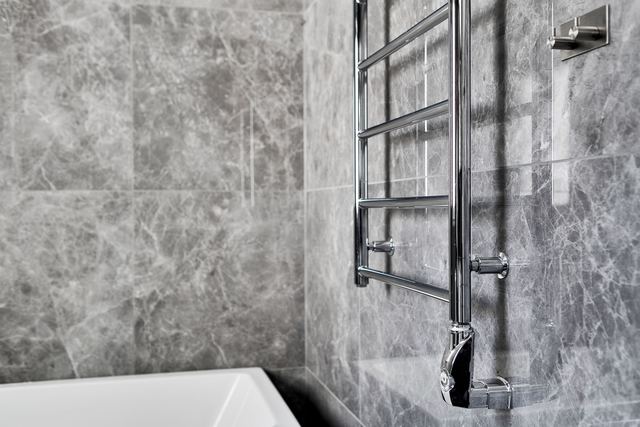
Towel rails: plug-in or hard-wired?
A plug-in rail is the simple option where there's an outlet well clear of the shower and bath. A hard-wired rail looks tidier, with no cord hanging down, and is usually run from a switch or timer outside the wet zone.
A timer is worth having. It stops the rail running all day while the house is empty, and means the towels are warm when you actually want them.
Underfloor heating goes in before the tiles
Electric underfloor heating is a mat or cable laid on the floor and buried in tile adhesive or a screed. Once the tiles are down, the only way back to it is lifting them, so the electrician and the tiler have to work in the right order.
A typical sequence: the electrician runs the supply and the thermostat cable, the mat is laid and tested, the tiler tiles, and the electrician tests the mat again before connecting the thermostat. Ask for both sets of test results in writing.
Have the thermostat's floor sensor placed between heating runs rather than on top of one, so it reads the floor and not the cable.
Can it count for a rental's heating standard?
Only in the main living room. Tenancy Services' July 2025 heating guide says electric underfloor heating may be an acceptable heater if it heats that room directly, has a thermostat, and has a capacity between 1.5 and 2.4 kW.
Heating in a bathroom, whether it's a warm floor or a towel rail, doesn't help a rental meet the standard, which is about the main living room. In any rental, this is a job for a licensed electrical worker: landlords and tenants can't do electrical work there.
Why a bathroom changes the job
Bathrooms are damp areas, and the Electrical Workers Registration Board (EWRB) recommends homeowners don't replace fittings in damp areas like bathrooms. Electricians plan where switches, timers and thermostats go so they're out of reach from the shower or bath.
WorkSafe points out that AS/NZS 3000 requires an RCD protecting any new final subcircuit in a home, so a dedicated circuit for the floor or rail comes with one. New or extended wiring is general work, which means a Certificate of Compliance and an Electrical Safety Certificate at the end.
Your part, and the licensed part
You can
- Choose plug-in rails only where an outlet sits well away from water.
- Set timers and thermostats to suit how the room is used.
- Tell your tiler early that underfloor heating is going in.
Leave to a licensed electrician
- Hard-wiring a towel rail, its switch and its timer.
- Running the supply and thermostat for floor heating, and testing the mat before and after tiling.
- A new circuit and its RCD at the switchboard.
- Any electrical work in a rental bathroom.

How we'd go about it
If we were renovating, we'd decide on floor heating before the floor is prepped, put the towel rail on a timer, and have one electrician wire both on the same visit as the extractor fan. Then we'd ask for the mat's test results from before and after tiling, on paper.
Want a specialist to sort it?
Tell us the job and your postcode. We match the licence-checked local electrician who does this kind of work, and they call you. No ring-around, and your number goes to them alone.